
Autonomous Mobile Robots (AMRs) are transforming warehouses, factories, and industrial environments by moving intelligently without fixed paths or magnetic tracks. Unlike traditional automated vehicles, AMRs can understand their surroundings, avoid obstacles, and make real-time navigation decisions.
The core technologies behind this intelligence are LiDAR sensors, artificial intelligence, advanced mapping systems, and real-time obstacle detection. Together, these technologies allow AMRs to operate safely and efficiently in dynamic industrial environments.
—
## What Is LiDAR?
LiDAR stands for “Light Detection and Ranging.” It is one of the most important technologies used in autonomous mobile robots.
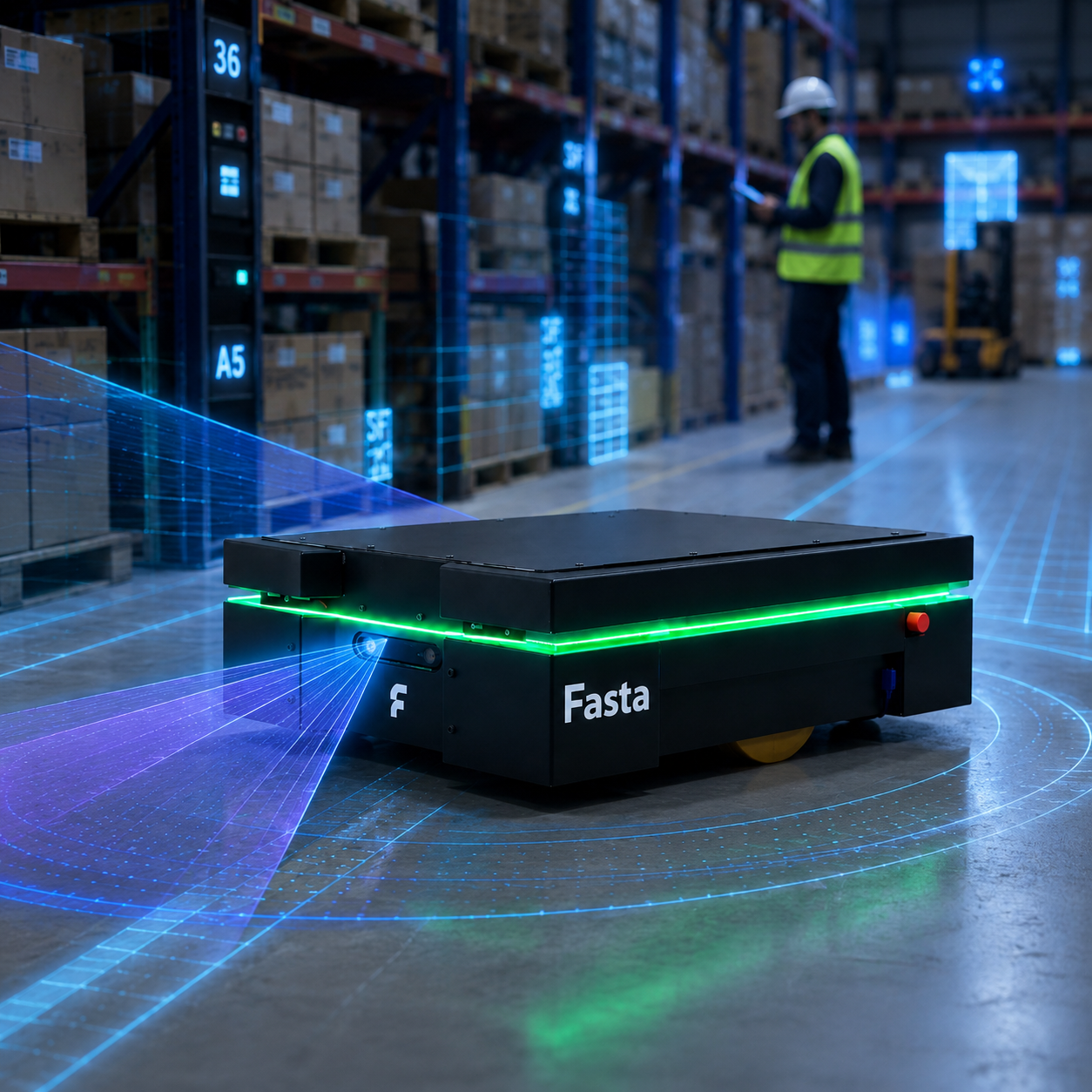
LiDAR sensors emit laser beams in multiple directions and measure how long it takes for the light to return after hitting an object. By continuously scanning the environment, the robot creates a highly accurate 3D map of its surroundings.
This allows the AMR to:
– Detect walls, shelves, pallets, and workers
– Measure distances with high precision
– Navigate safely in real time
– Continuously update its environment map
In modern warehouses, LiDAR acts as the “eyes” of the robot.
—
## How AI Helps AMRs Make Decisions
Artificial intelligence enables AMRs to analyze sensor data and make intelligent decisions while moving.
The AI system inside the robot processes information from:
– LiDAR sensors
– Cameras
– Ultrasonic sensors
– Depth sensors
– Wheel encoders
Using this data, the robot can:
– Select the best route
– Avoid moving obstacles
– Recalculate paths instantly
– Optimize travel efficiency
– Adapt to changing environments
Unlike AGVs that follow fixed routes, AMRs can dynamically navigate around unexpected obstacles without stopping operations.
—
## Simultaneous Localization and Mapping (SLAM)
Most modern AMRs use a technology called SLAM, which stands for Simultaneous Localization and Mapping.
SLAM allows the robot to:
1. Build a map of the environment
2. Determine its own position inside that map
3. Continuously update navigation in real time
This technology is essential for autonomous operation in large warehouses and industrial facilities where layouts can frequently change.
For example, if a pallet blocks a route, the AMR can instantly calculate an alternative path without human intervention.
—
## Obstacle Detection and Collision Avoidance
Safety is one of the biggest advantages of AMRs.
Advanced AMRs constantly scan their surroundings to detect:
– Human workers
– Forklifts
– Boxes and pallets
– Other robots
– Temporary obstacles
When an object appears in the robot’s path, the AMR can:
– Slow down
– Stop immediately
– Change direction
– Select a safer route
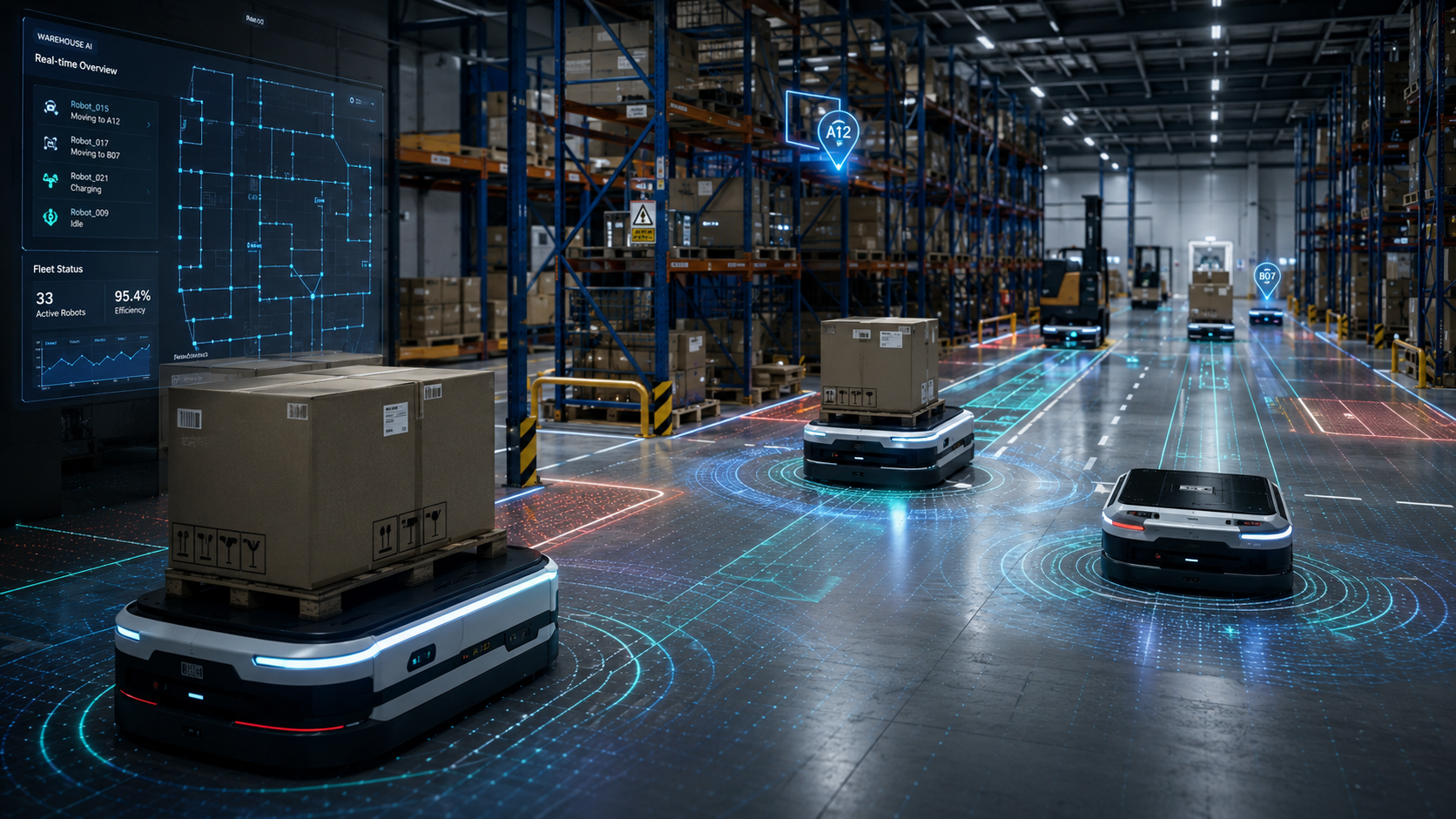
This real-time responsiveness significantly improves workplace safety compared to traditional material handling systems.
—
## Indoor vs Outdoor Navigation
Navigation technology can vary depending on the environment.
### Indoor AMRs
Indoor robots mainly rely on:
– LiDAR
– SLAM mapping
– QR markers
– Cameras
They are optimized for smooth warehouse floors and controlled environments.
### Outdoor and Off-Road AMRs
Outdoor AMRs require additional technologies such as:
– GPS
– RTK positioning
– Rugged LiDAR systems
– Terrain adaptation algorithms
These robots are designed for construction sites, mining operations, and rugged industrial environments.
—
## Benefits of AI-Powered Navigation in AMRs
Modern AI-driven navigation provides several industrial advantages:
– Increased operational efficiency
– Reduced labor costs
– Higher workplace safety
– Flexible workflow automation
– Faster material transportation
– Scalability for large facilities
As industrial automation continues to evolve, intelligent navigation systems are becoming the foundation of smart factories and next-generation logistics.
—
## Conclusion
AMRs use a combination of LiDAR, artificial intelligence, SLAM mapping, and real-time sensor fusion to navigate safely and autonomously.
Unlike traditional automated systems, AMRs can adapt to changing environments, avoid obstacles dynamically, and operate efficiently without fixed infrastructure.
As warehouses and factories move toward Industry 4.0, intelligent autonomous navigation will continue to play a critical role in the future of industrial automation.